


- Back
- 2026
- 2015
- 2016
- 2017
- 2018
- 2019
- 2020
- 2021
- 2022
- 2023
- 2024
- 2025
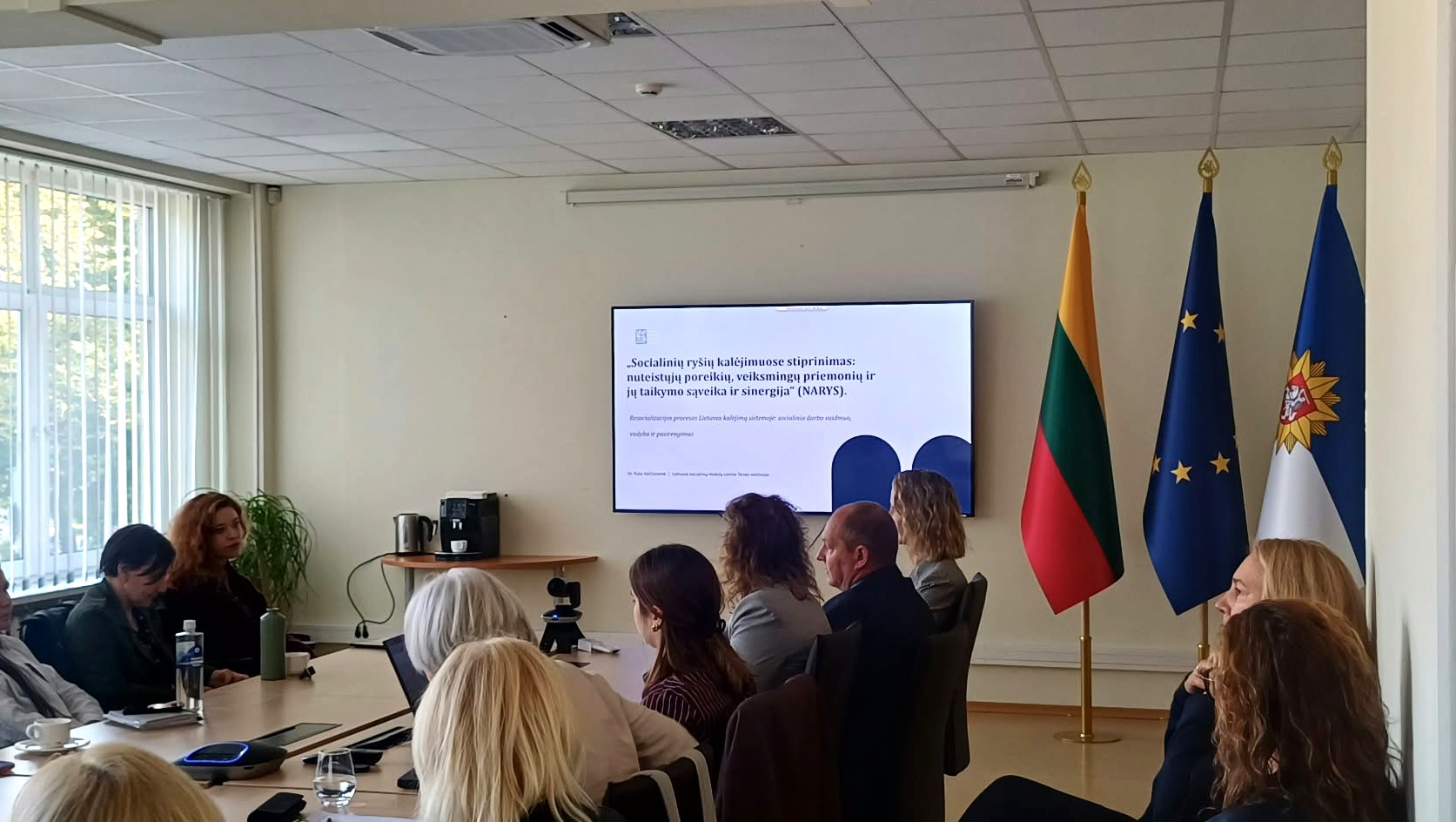
On September 29, the Lithuania Prison Service hosted the final seminar “Social Relations in Prison: Practices and Opportunities” of the project “Strengthening social relations in prisons: interplay and synergy between prisoners’ needs, effective measures and their implementation” (NARYS), implemented by the Law Institute of the Lithuanian Centre for Social Sciences. The event was dedicated to commemorating Social Workers' Day.
The aim of the NARYS project was to analyze the practical implementation of measures applied in Lithuanian prisons to maintain and restore the social relations of incarcerated individuals—from the perspectives of both social workers and inmates. The study sought to review international best practices in social work with families, evaluate current practices, challenges, and quality, and develop recommendations for a sustainable social work model. The project implementers, researchers from the LCSS Law Institute Dr. Rūta Vaičiūnienė, Goda Dainauskaitė, Aušra Maskaliovienė, and Agata Katkonienė, presented the results of the conducted research at this scientific seminar.
In her presentation, the project leader Dr. Rūta Vaičiūnienė discussed three role strains of a social worker operating in prison—role overload, role conflict, and role ambiguity—as well as seven adaptation mechanisms: strategies that workers use to balance impossible demands. Doctoral student Goda Dainauskaitė presented the spectrum of measures for maintaining social relations in Lithuanian and foreign prisons and looked at relations with loved one as a motivation for prisoners to make an effort, as a practical resource when relatives help resolve various issues, and at the same time as a certain risk (e.g., financial exploitation of relatives). Agata Katkonienė outlined the four stages of a social worker's work with an inmate: need recognition, setting an individual plan, action, and intervention evaluation, and provided concrete recommendations that could be implemented in practice as early as tomorrow. Aušra Maskaliovienė focused on the practices of maintaining contact with children during imprisonment: telephone and video calls, contact visits, short-term outings, and family day events, and discussed the challenges, benefits, and best practices of these methods of maintaining contact.
The project “Strengthening social relations in prisons: interplay and synergy between prisoners’ needs, effective measures and their implementation” (NARYS), implemented by the Law Institute of the Lithuanian Centre for Social Sciences, was funded by the Research Council of Lithuania (LMTLT) under its supported measure "Targeted Research Projects", contract No. S-REP-25-7.
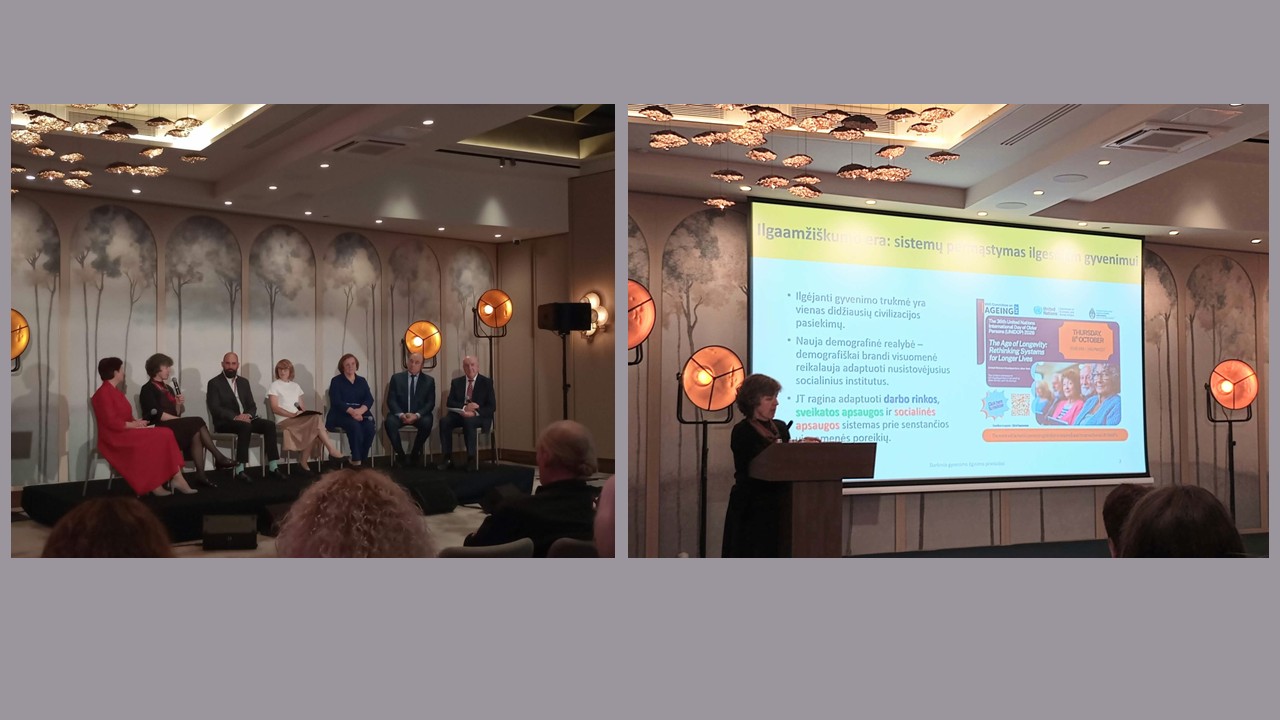
2026 m. rugsėjo 30 d. „Grand Hotel Vilnius“ vykusioje Lietuvos Respublikos socialinės apsaugos ir darbo ministerijos konferencijoje „Ilgaamžiškumo era: kuriame sistemas ilgesniam ir kokybiškam gyvenimui“, skirtoje Tarptautinei pagyvenusių žmonių dienai, Lietuvos socialinių mokslų centro Sociologijos instituto sociologė dr. Sarmitė Mikulionienė, dirbanti šio centro Teisės instituto įgyvendinamame mokslininkų grupių projekte VAM, skaitė pranešimą „Kaip kurti lanksčią, amžiui ir lytims jautrią darbo rinką ilgaamžiškumo eroje? Darbinio gyvenimo ilginimo prielaidos“. Remdamasi K. Nilsson (2024) „Tvaraus darbinio gyvenimo visoms amžiaus grupėms – SwAge“ teoriniu modeliu ir SHARE duomenimis (N=2745, 55 m. ir vyresni Estijos, Latvijos, Lietuvos ir Lenkijos darbuotojai), analizuotais CHAID algoritmais, mokslininkė pabrėžė, jog mechaninis pensinio amžiaus didinimas nebeužtikrina tvaraus aktyvumo vyresniame amžiuje. Tyrimas atskleidė drastišką teisinio reguliavimo poveikį: Estijos „švelnusis“ modelis, leidžiantis laisvai derinti pensiją ir darbines pajamas, lemia, kad tik 16 % 55 metų ir vyresnių dirbančių moterų ir 18 % tokių pat vyrų siekia kuo greičiau pasitraukti iš darbo rinkos. Tuo tarpu Lietuvos „griežtasis“ modelis sukelia sisteminį darbuotojų nuovargį – net 83 % minėto amžiaus dirbančių moterų ir 86 % vyrų nori išeiti į pensiją pasitaikius pirmai progai. Siekiant sudaryti palankias sąlygas ilgesniam darbiniam gyvenimui, mokslininkė siūlo diegti teisinį lankstumą (leidžiantį kiekvienam darbuotojui rinktis darbinės veiklos ir gaunamų pensinių išmokų derinius, tinkamus jo konkrečiai situacijai); stiprinti profesinės sveikatos stebėseną ir ligų prevenciją bei darbo vietos ergonomines savybes. Kartu svarbu darbovietėse taikyti lytims jautrius standartus – skatinančius darbo užduočių atlikimo autonomiją ir nediskriminavimą, stiprinančius darbuotojų socialinę įtrauktį bei emocinę sveikatą. Prioriteto tvarka ypatingą dėmesį ir lėšas būtina skirti žemesnio išsilavinimo darbuotojų darbo sąlygų tobulinimui bei kvalifikacijos kėlimui, nes būtent jie yra pažeidžiamiausi ilgalaikio užimtumo atžvilgiu. Taip adaptuoti socialiniai institutai leis ilgaamžiškumą paversti visuomenės stiprybės šaltiniu.
Pranešimas parengtas remiantis Lietuvos mokslo tarybos finansuojamo projekto „Vyresnio amžiaus moterų darbinio gyvenimo (ne)ilginimas: teisinė aplinka, garantijos ir ketinimai – VAM“ (sutarties Nr. S-MIP-24-29) rezultatais.
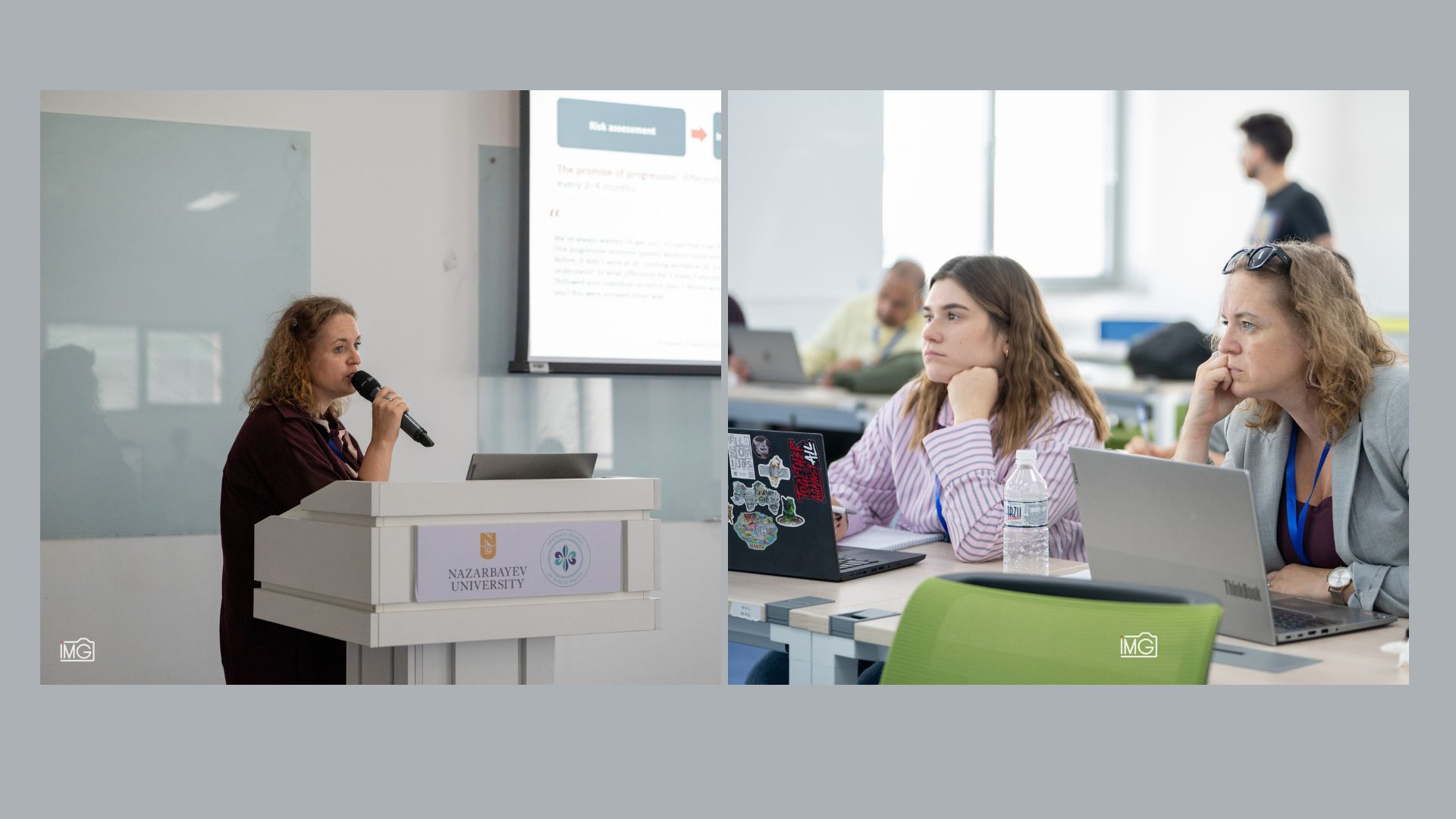
On September 17–19, Dr Rūta Vaičiūnienė, Chief Researcher, and Goda Dainauskaitė, Junior Researcher at the Law Institute of the Lithuanian Centre for Social Sciences (LCSS), participated in the 6th Annual International Conference "Punishment in Global Peripheries", held this year in Astana, Kazakhstan. This Central Asian country was not chosen for the conference by accident—the area around Astana was an important site of Soviet convict settler colonialism, and Kazakhstan today is a country experiencing dynamic processes of penal change. This year, Nazarbayev University (Kazakhstan) joined the conference organisers—the University of Oxford (UK), the National University of the Littoral (Argentina), the University of A Coruña (Spain), and the University of Sheffield (UK) - as a co-host.
R. Vaičiūnienė and G. Dainauskaitė delivered a presentation titled "Penal Modernity at the European Periphery: Glocal Prison Governance in Lithuania." The researchers highlighted that Lithuanian prisons remain a site where European penal norms continue to encounter the enduring legacy of Soviet punishment practices. Decades of reform have introduced Western managerial elements, yet Soviet-era practices have not disappeared. Rather than displacing one another, both coexist, producing a distinctively glocal form of prison governance. Here, global and European penal models are reinterpreted and fused with locally entrenched institutional logics and informal power arrangements. The presenters' research reveals that this situation should be understood not merely as hybridisation, but as the active encounter between global penal models and local institutional realities.
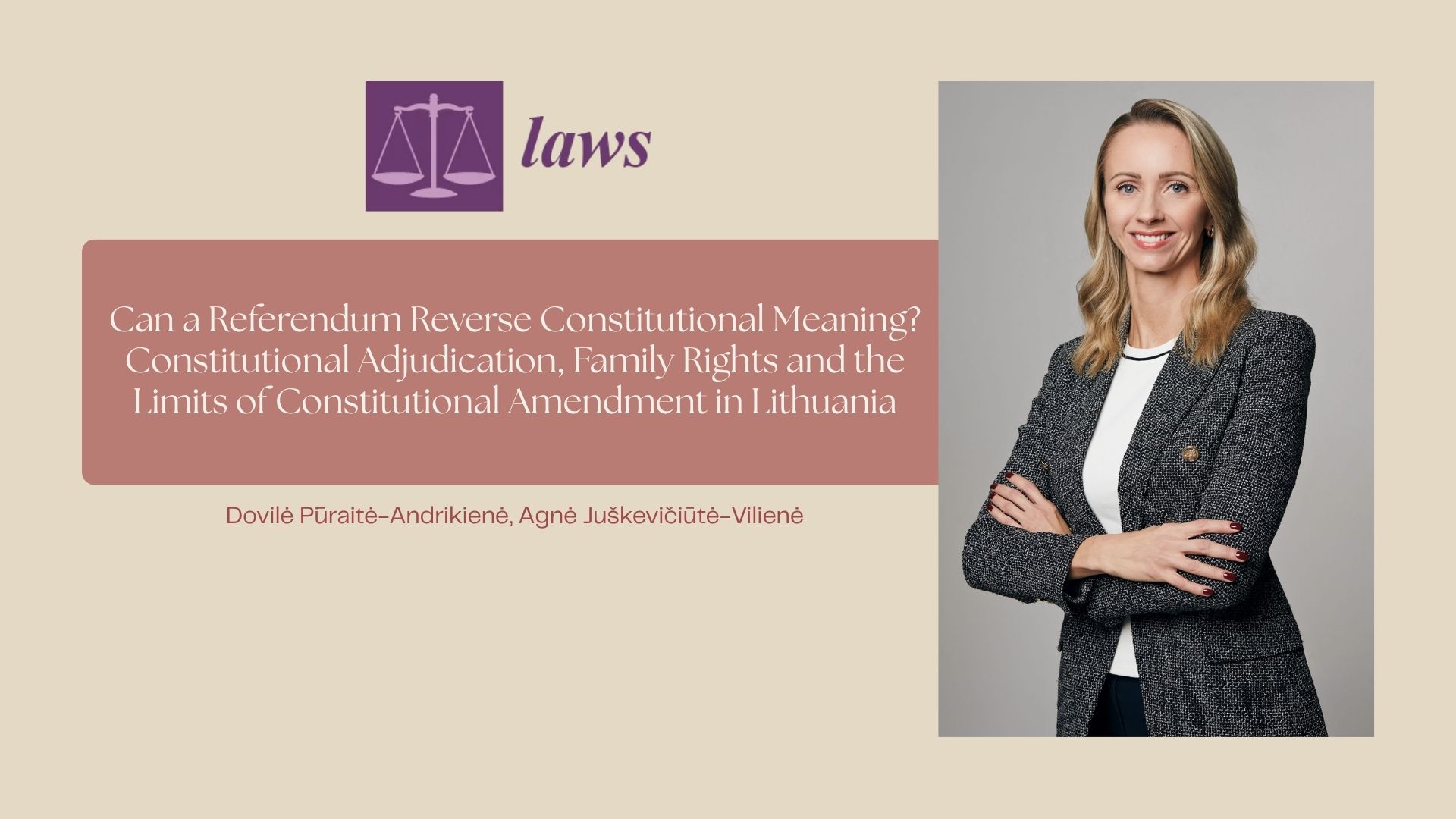
An open-access article titled “Can a Referendum Reverse Constitutional Meaning? Constitutional Adjudication, Family Rights and the Limits of Constitutional Amendment in Lithuania” by Dr. Dovilė Pūraitė-Andrikienė and Dr. Agnė Juškevičiūtė-Vilienė, researchers at the Law Institute of the Lithuanian Centre for Social Sciences (LCSS), has been published in the international academic journal “Laws”. The article examines a proposal by a group of Lithuanian parliamentarians to hold an advisory referendum concerning an amendment to Article 38 of the Constitution. The proposed amendment would link the constitutional concept of family exclusively to marriage between a man and a woman, motherhood and fatherhood.
The authors ask what limits the Constitutional Court’s interpretation of family and the protection of fundamental rights place on such an initiative. They argue that the proposed amendment would seek to reverse the understanding of family developed in the Court’s case law. The article considers the substantive limits on constitutional amendments, legal certainty, Lithuania’s obligations under the ECHR and EU law, the case law of the ECtHR and CJEU, and comparative constitutional practice. It emphasises the role of constitutional courts in safeguarding fundamental rights when constitutional change is pursued through referendums.
The full open-access article can be found here: https://www.mdpi.com/2075-471X/15/5/122
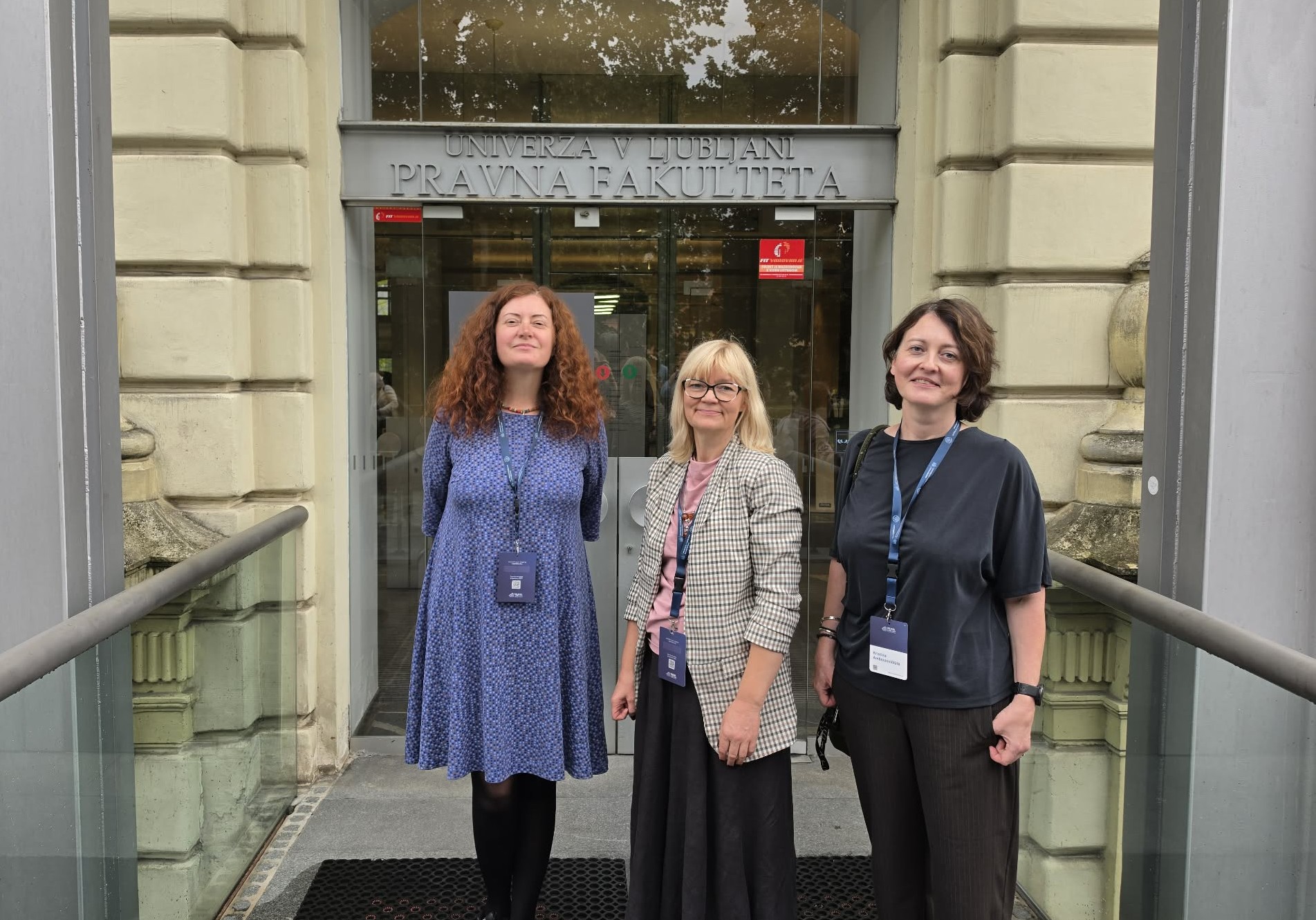
On September 17, 2026, researchers from the Law Institute of the Lithuanian Centre for Social Sciences – Dr. Kristina Ambrazevičiūtė, Dr. Raimonda Bublienė, and Dr. Ingrida Mačernytė-Panomariovienė – participated in the XV European Congress of the International Society for Labour and Social Security Law (ISLSSL), held in Ljubljana, Slovenia. This year, the congress participants were brought together by the event's theme and title: "Social Europe under Strain – Contemporary Challenges of National and European Labour and Social Security Laws."
Dr K. Ambrazevičiūtė presented a paper entitled “Age and Gender Non-discrimination in Labour Law: Challenges for Older Working Women in the Baltic States”, in which she discussed and compared the situation of older women in employment in Lithuania, Latvia and Estonia, focusing on protection against discrimination on the grounds of age and gender, possibilities for individualising working conditions, and legal protection upon termination of employment. The researcher noted that although employment rates among older women (aged 55–64) in all three countries exceed the European Union average, the nature and strength of legal measures supporting their continued participation in employment differ. The comparison also showed that the strength of the legal measures examined does not directly correspond to the employment rate of older women: stronger formal legal guarantees are established in Lithuania, while Estonia has the highest employment rate among women aged 55–64. This suggests that the continued participation of older women in the labour market is determined by a broader range of factors, with labour law regulation being only one part of the overall picture.
This presentation was prepared within the project "(Not)prolonging the Working Life of Older Women: Legal Environment, Guarantees and Intentions" (VAM), implemented by the Law Institute of the Lithuanian Centre for Social Sciences and funded by the Research Council of Lithuania. For more information about this project, see https://teise.org/en/projektai/vam/
Dr. R. Bublienė and Dr. I. Mačernytė-Panomariovienė, in their presentation "Intersectional Discrimination and Equal Pay," identified economic inequality resulting from female unemployment and reduced labour income as a structural inequality in society characterized by a lack of opportunities. Women face part-time work, career breaks due to care responsibilities (maternity or other reasons), poverty-driven occupational segregation, and the glass ceiling effect more frequently than men. All of this carries long-term consequences, impacts pay transparency and labour income, and has implications for future pensions.
This presentation was prepared within the postdoctoral fellowship project "Multiple Discrimination and Labour Income: A Comparative Analysis of Legal Regulation in European Countries (MEDALIC)," implemented by the Law Institute of the Lithuanian Centre for Social Sciences and funded by the Research Council of Lithuania. For more information about this project, see https://teise.org/en/projektai/medalic/
A research article by Dr Raimonda Bublienė and Dr Ingrida Mačernytė-Panomariovienė, researchers at the Law Institute of the Lithuanian Centre for Social Sciences, and Dr Aurelija Burinskienė, Associate Professor at Vilnius Gediminas Technical University, entitled “Intersectional Discrimination in Employment in the Digital Age: Sex, Age, Email Non-Use and Unemployment in the EU”, has been published in the international open-access journal “Social Sciences.”
The article uses Eurostat data for the 27 EU Member States for 2016–2025 and applies two-way fixed-effects models to examine the association between email non-use and unemployment, separately for men and women aged 25–54 and 55–74. The researchers found a positive association between higher rates of email non-use and unemployment among people aged 25–54. However, this association is not sufficiently robust: the results change substantially when country-specific linear trends are included, while additional analysis also raises concerns about the temporal ordering of the variables. The estimates for the 55–74 age group are statistically inconclusive. The authors therefore emphasise that the observed relationships should be understood as specification-sensitive conditional associations rather than causal relationships. Email non-use does not in itself measure digital skills, while the statistical data do not allow for determining whether individuals experienced discrimination or which specific factors contributed to their unemployment. The findings do not support the conclusion that reducing email non-use would reduce unemployment. The article notes that further research on intersectional discrimination should examine separately the specific barriers that may be faced by women from ethnic minorities, older women and women with disabilities, while avoiding the assumption that the experiences of all these groups are uniform.
The article was prepared as part of the postdoctoral fellowship project “Analysis of Multiple Discrimination and Labour Income: A Comparative Study of the Legal Regulation in European Countries (MEDALIC)”, implemented at the LSMC Law Institute and funded by the Research Council of Lithuania. More information about the project is available here: https://teise.org/en/projektai/medalic/.
The full article is available here.
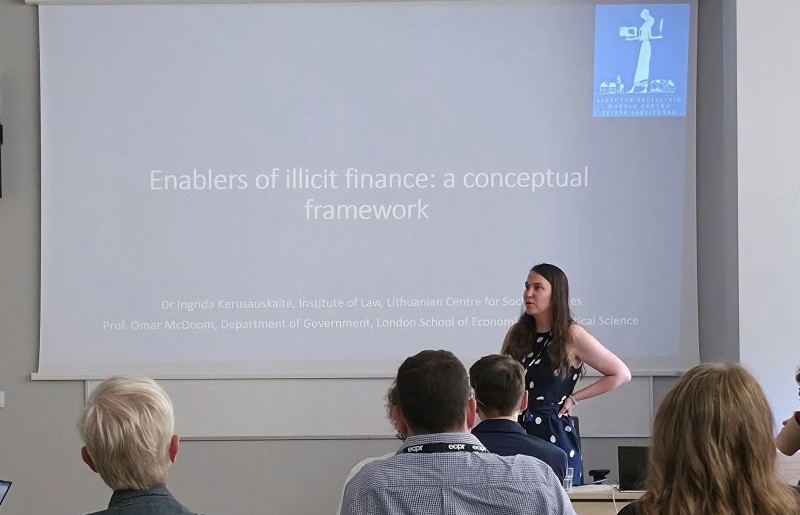
On 9 September this year, Dr Ingrida Kerušauskaitė-Palmer, Senior Researcher at the Law Institute of the Lithuanian Centre for Social Sciences (LCSS), participated in the European Consortium for Political Research (ECPR) General Conference held at Jagiellonian University in Kraków, Poland. The ECPR General Conference is Europe’s largest annual gathering of political scientists, bringing together thousands of scholars and practitioners to present the latest research and promoting the translation of research insights into practical solutions.
At the conference, the Law Institute researcher delivered a presentation entitled “Enablers of Illicit Finance: a Conceptual Framework”, in which she presented research conducted jointly with Dr Omar McDoom, a researcher at the London School of Economics and Political Science, and the article based on this research. In recent years, increasing attention has been devoted to enablers of corruption and financial crime in public discourse, policy-making, and scholarly discussions. Major exposes such as the Panama Papers, Pandora Papers, and FinCEN Files have highlighted the role that individuals and firms play in facilitating the movement of funds and the formation of companies used to hide and benefit from illicit funds.
In the article presented at the conference, the authors developed a conceptual framework for identifying such profesional enablers of illicit finance and distinguishing them from adjacent concepts such as gatekeepers, intermediaries, facilitators, and principals. The framework identifies ten dimensions of enabling, organised into scope, constitutive, and normative categories. The new definition identifies actors who willingly or negligently allow individuals and corporations to hide, move, protect, launder, invest, or enjoy the benefits of illicitly obtained or transferred funds, resulting in economic, social, or political harm. The article concludes by linking differing enabler mental states to proportionate regulatory, supervisory, educational, exposure, and sanctioning responses.

Šiemetinio 43-iojo Tarptautinio ekonominių nusikaltimų simpoziumo tema buvo „Turto susigrąžinimas ir teisinės valstybės principas – nusikalstamos veiklos pelno atėmimas: nuo retorikos prie realių rezultatų“ (angl. „Asset Recovery and the Rule of Law - Taking the profit out of crime – from rhetoric to results“). Džiaugiamės, kad šios milžiniškos konferencijos, vykusios rugpjūčio 23–30 dienomis Kembridžo universitete ir pritraukusios per 2000 ekspertų iš viso pasaulio, rengėjų sąraše įrašytas ir Lietuvos socialinių mokslų centro (LSMC) Teisės institutas. Šiame renginyje pranešimus skaitė du Teisės instituto mokslininkai – dr. Ingrida Kerušauskaitė-Palmer ir dr. Skirmantas Bikelis. Be to, dr. I. Kerušauskaitė prisidėjo ir prie simpoziumo organizavimo. Jai talkino ir simpoziumo sekretoriate savanoriavusi LSMC Teisės instituto projektų administratorė Karolina Vysockytė.
Dr. I. Kerušauskaitė-Palmer, LSMC Teisės instituto vyresnioji mokslo darbuotoja, šiais metais koordinavo dviejų dienų alternatyviąją programą „Geopolitinė strateginė korupcija ir neteisėti finansiniai srautai“ (angl. „Geopolitical strategic corruption and illicit finance – Under the auspices of the Centre of Development Studies, University of Cambridge and the Institute of Law, Lithuanian Centre for Social Sciences“). Ingrida tarė įžangos žodžius ir moderavo pirmas sesijas abi programos dienas – pristatė pagrindines sąvokas, strateginės korupcijos priemones, metodus ir apraiškas bei aptarė pagrindinius iššūkius ir klausimus, kuriuos nagrinėja akademinė literatūra, o paskutinę dieną apibendrino visą programą. Taip pat tyrėja perskaitė tris pranešimus, du iš jų – plenarinėse simpoziumo sesijose. Pirmajame pranešime sesijoje „Ką turėtume daryti su susigrąžintais pinigais ir ką galime su jais daryti?“ (angl. „What should we do and what can we do with the money we recover?“) dr. Ingrida Kerušauskaitė-Palmer pristatė knygos skyrių, kurį parašė kartu su dr. Skirmantu Bikeliu, apie konfiskuoto turto pakartotinį panaudojimą (angl. asset reuse). Ingrida aptarė jos ir Skirmanto sukurtą modelį, kaip jie kategorizuoja atgauto turto panaudojimą socialiniams ir administraciniams tikslams. Antrajame pranešime sesijoje „Plenarinis praktinis seminaras Nr. 48 – ką tai reiškia šiuolaikiniame pasaulyje?“ (angl. Plenary Workshop 48 – what does it mean in the modern world?") Ingrida kalbėjo apie korupciją ir socialines normas bei skirtumą tarp tapatybinio ir „vienkartinio“ korupcijos suvokimo. Paskutinę simpoziumo dieną mokslininkė skaitė pranešimą ir diskutavo apie žurnalo „International Journal of Economic Crime“ strategiją. Ingrida yra šio tarptautinio mokslinio žurnalo vyriausiojo redaktoriaus pavaduotoja.
Dr Skirmantas Bikelis presented two papers at the symposium. During the session “Non-Conviction-Based Forfeiture”, he presented “Civil (?) Confiscation in Lithuania and the EU Legal Framework,” discussing civil confiscation – a field that the researcher has been studying for many years and on which he has published numerous academic papers. In the session “What and Who Are We Missing in Our Discussions on Strategic Corruption and Illicit Finance?”, Skirmantas delivered his second presentation, “Threats as Strategic Corruption?”, addressing the concept of geopolitical (strategic) corruption.

Dr. Sarmitė Mikulionienė, Senior Researcher at the Law Institute of the Lithuanian Centre for Social Sciences (LCSS) and lead researcher of the VAM project, participated in the 17th Conference of the European Sociological Association (ESA), “Strengthening Democracies: Social Action, Solidarity, and Sustainable Futures".
The conference was held in Warsaw, Poland, on 25-28 August 2026. Dr. Mikulionienė presented research examining the factors that influence older people’s intentions either to continue working or to leave the labour market as soon as possible, with particular attention paid to gender differences. In the session devoted to social justice and ageism at work, Dr. Mikulionienė presented a paper entitled “Determinants of Extended Working Lives: Gendered Profiles”. The presentation featured findings from the ongoing project “(Not)prolonging the working life of older women: legal environment, guarantees and intentions” (VAM).
Using microdata from the SHARE database (N = 2,745), the study examined and compared the work intentions of employees aged 55 and over in Estonia, Latvia, Lithuania, and Poland. Particularly striking contrasts were found between Estonia and Lithuania. Estonia is characterised by a “flexible” or “soft” retirement model, with as many as 84% of older workers expressing a desire to remain active in the labour market. In Lithuania, by contrast, a “hard” retirement model predominates: due to the inflexibility of the system, older workers experience what can be described as systemic fatigue, with as many as 85% expressing a desire to leave the labour market as early as possible.
Based on the SwAge methodology and decision-tree analysis, the study identified specific barriers and motivational factors that vary according to workers’ gender and level of education. The findings demonstrate that simply increasing the statutory retirement age is not sufficient to encourage older people to remain in employment.
Dr. Mikulionienė emphasises that public policy should focus on:
1. Flexibility adapted to health conditions: moving away from rigid employment and retirement models towards solutions that can be adapted to workers’ health and individual circumstances.
2. Gender-sensitive psychosocial working environment indicators: creating working environments that take into account gender-specific priorities and the different factors that motivate older women and men to remain active in the labour market for longer.
Dr. Sarmitė Mikulionienė’s participation in the conference and the research presented were funded by the project “(Not)prolonging the working life of older women: legal environment, guarantees and intentions” (VAM, Contract No. S-MIP-24-29).
Pabaiga